
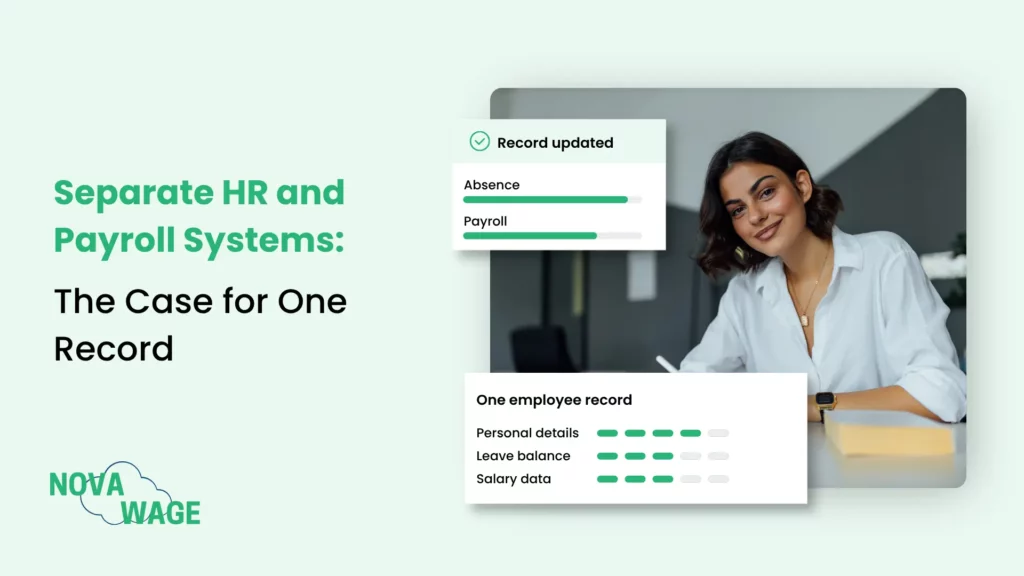
A new person starts on Monday. Before they do, their details have to exist in two places — once where holidays and absences are kept, and once where salaries are run. Name, address, start date, percentage, bank details, canton.
Neither entry takes long. Nothing goes wrong that morning. Separate HR and payroll systems are the normal starting point for a small Swiss company, and for a while they cost nothing at all.
What they cost arrives later, and it arrives quietly: at month-end, at year-end, and on the day someone leaves.
Why separate HR and payroll systems happen in the first place
Almost nobody chooses two systems. They accumulate.
Payroll comes first, because it is the one thing a business cannot postpone — salaries go out, contributions get declared, and the canton has an opinion about all of it. Absence starts later, as a calendar or a spreadsheet, because in the early years there genuinely isn’t much to track. It only becomes a system once someone’s remaining holiday stops being something anyone can hold in their head.
Two problems, arriving years apart, solved by different people. That is how a company ends up running HR and payroll separately without ever deciding to.
It works. This guide is about what it costs once the team outgrows the point where one person can see everything at once.
Where the two sets of records drift apart
The two systems don’t disagree because either one is wrong. They disagree because every change has to be made twice, and the two entries are separated by time.
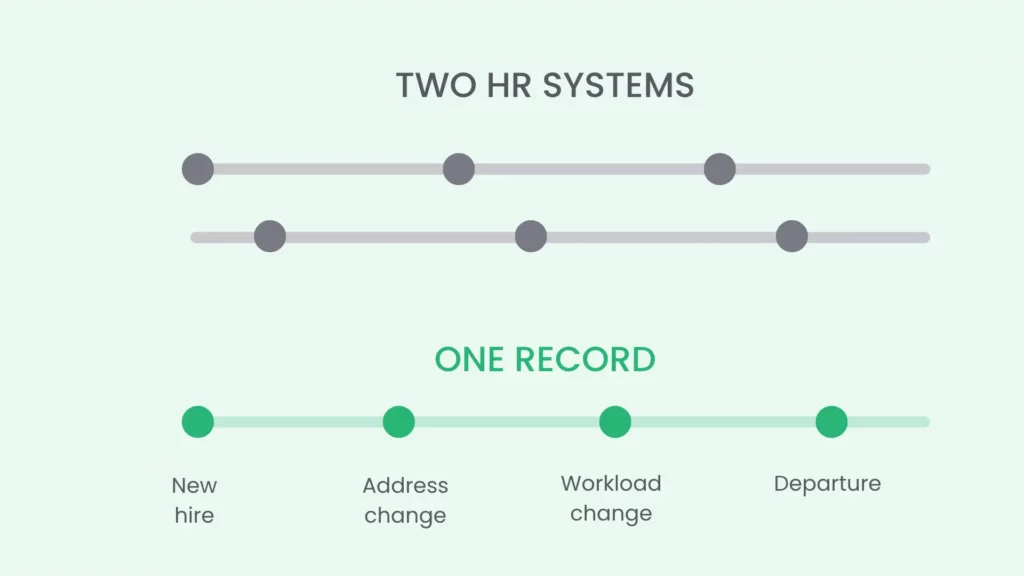
A new hire. An address change. A move from 80% to 100%. Someone who leaves in April. Each is one event in the life of your business and two pieces of data entry — and in many Swiss SMEs the two entries are not even in the same building, because payroll sits with a fiduciary who runs it monthly from whatever you send across.
What that drift actually costs — in reconstructed month-ends, in balances that don’t match, in the figure someone has to assemble by hand — is a subject of its own.
What one employee record actually changes
The alternative isn’t a bridge between two systems. It is one record that both halves read from — and the difference shows up mostly in what stops happening. No overnight sync that quietly didn’t run, no field updated on one side and not the other, no question about which of two numbers is the real one. Nothing has to agree, because there is only one of it.
Entered once, used by both
Personal, family, tax and banking details are entered a single time, and both absence and payroll work from them. Every later change — the percentage, the address, the salary, the leave taken — stays in that same file, so “what was their situation in March?” has one place to look rather than two to reconcile.
Leave balances that reach the money
Unused holiday is where an HR number turns into a financial one: a provision on your books at year-end, and a line in someone’s final settlement when they leave. Both need the leave balance and the salary it is worth, at the same time.
Because they sit in the same record, your vacation provision comes out as an accounting-ready figure before you close the year, and a departing employee’s balance is factored into their final settlement without a manual recalculation. Neither is a time-saver in the ordinary sense. Both are the removal of a specific afternoon.
One place your team goes
Your employees get one door instead of two: request leave, check the balance, open a pay slip, on a phone or in a browser. Managers get the same door, and approval responsibility can sit with more than one person — which matters in a small team, where the alternative is that everything waits for whoever is travelling.
Notifications carry the rest: an alert when a request needs approving, an alert when a payroll deadline is due. Nobody chases you, and you don’t check two systems to find out whether anything is waiting.
The Swiss layer the record has to survive
A single record is convenient. In Switzerland it is also the thing you have to be able to produce.
What you must still be able to produce
Swiss record-keeping obligations outlast the employment itself: payroll documents, working-time records and the personnel file each carry retention requirements, some running for years after someone has left. A record split across two systems is two halves to keep and two exports to reconcile if anyone asks — the obligation doesn’t change when your systems do, only how long it takes to answer.
Certified, and hosted here
The rules underneath are the part we solved so your screen doesn’t have to show them: all 26 cantons built in, with cantonal leave rules, source tax, AVS and contributions applied per canton and kept current. Declarations go out through Swissdec, which flags errors while they’re still fixable — NovaWage is certified at Swissdec 5.0 and self-validated through 5.3. Your data is hosted in Switzerland, handled in line with nFADP and GDPR, on ISO 27001 certified infrastructure, which matters most for the parts of a personnel file that aren’t ordinary business data — medical certificates above all.
Worth being exact about: the system holds the rules and applies them. The legal responsibility stays with you. What changes is that meeting it stops being manual.
Sorting out the payroll half first ? Our guide to Swiss payroll compliance covers what the salary side has to get right on its own: source tax, AVS, and the 26-canton logic sitting under all of it.
→ Read the full guide: Swiss Payroll Compliance: The Complete Guide for SMEs
Seeing both halves without opening two systems
Once both halves share a record, they can be read together. Pending requests sit on one screen, the shared calendar shows who is already away, and when numbers are needed elsewhere — your accountant, an audit, your own planning — absence and payroll export together as CSV, XLSX or PDF rather than two sets that have to be lined up first.
The difference isn’t about screens. It is that a question about your own company stops requiring an investigation. How many days is the team carrying into next year, and what are they worth? Who was on reduced hours in the second quarter? Answerable while you’re asking, rather than postponed until you have a clear afternoon.
Moving from two systems to one
The honest version: importing your employee list is straightforward, and it is the part most owners expect to be worst.
You export what you already have, bring it in, and fill in your team’s sensitive data. Then you confirm your rules once: entitlements, approvals, who sees what, and your team downloads the app.
What takes time isn’t the transition itself. It’s making the decision and getting started.
One record, and what gets quieter
Running HR and payroll separately isn’t a loud mistake — it lingers because the cost hides in small, scattered tasks.
With one record, changes flow automatically: leave balances update, departures close cleanly, provisions generate, and answers sit in a single file.
Swiss rules don’t get simpler, but keeping them current becomes someone else’s job. Your responsibility stays the same, only with far less standing between you and the answer.
“You didn’t set out to run two systems. You just never had a reason to run one.”
See both halves running as one
One record for absences, payroll, provisions, and settlements — with transparent per‑employee pricing. No demo, no sales call.
See how we connect it all