
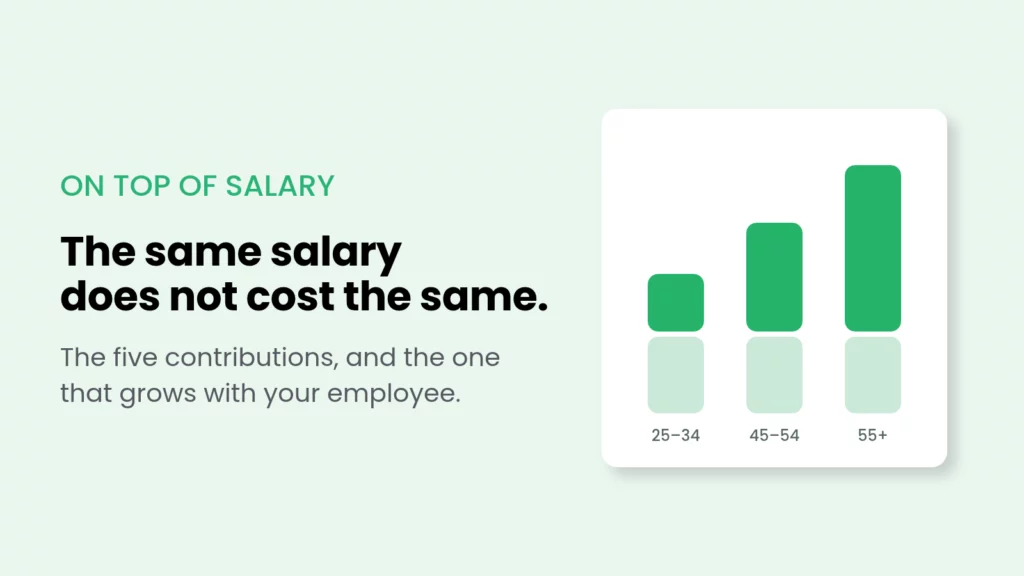
A salary is a number you agree once. What it costs you is a number that moves.
Most guides answer this with a single percentage to add on top. That figure is a useful rough cut, and it hides the thing that actually matters — because employer social insurance contributions in Switzerland are not one rate, and one part of them changes as your employee gets older.
Employer social insurance contributions in Switzerland are not one number
Every employee on your payroll triggers the same framework of federal obligations, whatever their nationality or permit. That part is simple, and our guide to Swiss payroll compliance sets out where it sits among the other rules.
What is less simple is that each component has its own base, its own ceiling and its own split between you and the employee. Some stop at a salary ceiling. One only begins above an entry threshold, and then applies to a slice of the salary rather than the whole of it.
So the honest answer to “what does this person cost me” is not a percentage. It is a short list of five parts — and four of them behave differently from the first.
What you are actually paying into
Old-age and survivors insurance, disability insurance and loss-of-earnings compensation (AHV/AVS, IV/AI, EO/APG) are collected together and applied to the whole salary, with you and your employee each paying half. That is the straightforward one.
Unemployment insurance (ALV/AC) splits the same way but stops at a salary ceiling, so it behaves like a flat rate until a salary passes that point and then stops growing.
Accident insurance (UVG/LAA) splits by cause rather than by half. Cover for accidents at work is yours to carry. Cover for accidents outside work is usually the employee’s, deducted from salary. Your rate also depends on the risk class of the work — which is why two businesses paying identical salaries can carry genuinely different employer costs.
Occupational pension (BVG/LPP) behaves least like the others. It starts only above an entry threshold, it is calculated on a coordinated portion of the salary rather than all of it, and your share is not fixed by a single national rate. More on that below, because it is the one that moves.
Family allowances (FAK/CAF) are set canton by canton, and in almost every canton they are funded by the employer alone rather than split.
In short: five obligations, and four of them follow their own rules.
The Compliance Self-Check for Swiss employers
Fifteen statements across payroll, year-end, source tax, absences and employee data — including whether every contribution you pay has a named recipient, a rate and a due date you could point to. There is no score to pass.
Get the Compliance Self-CheckWhy the same salary costs more at fifty than at thirty
Here is the part that changes over time.
The occupational pension contribution is not a flat rate. The law sets minimum retirement credits in bands by age, as a percentage of the coordinated salary, and they rise sharply across a working life. The Federal Social Insurance Office publishes the bands :
| Age | Retirement Credit |
|---|---|
|
Age 25–34 |
7% |
|
Age 35–44 |
10% |
|
Age 45–54 |
15% |
|
Age 55 to reference retirement age |
18% |
These are the legal minimums. Your pension fund’s plan may use its own scale — sometimes higher, sometimes flatter across ages — and your plan regulations show which one applies.
The same rates apply to men and women, though the reference age itself is still moving: under the AHV 21 reform it rises three months a year for women, reaching 65 in 2028.
Two things sit on top of these bands. First, the funding rule: your contribution must be at least equal to the sum of what all your employees pay, so at minimum you carry half. Second, these are the retirement credits — the savings portion only. Pension funds also charge risk cover and administration costs on top, which is why the total on a real pension statement is higher than the percentage in this table.
And the step is not gradual. Age bands run by calendar year rather than by birthday, so an employee who turns 45 in November moves into the higher band on 1 January of the year they turn 45, not in November. The increase arrives with the new year, for everyone it applies to, at once.
Which means a fifty-five-year-old and a thirty-year-old on the same salary do not cost you the same, and the gap is not small. The pension share more than doubles between the youngest band and the oldest.
This is not a reason to think differently about who you hire. It is a reason to know the number before you commit to it, and to understand why a payroll figure that was right in December can be wrong in January.
In short: one of your contributions rises with your employee’s age— and under the legal minimum, it more than doubles.
The part that changes with the canton
Family allowances are the component that does not follow a single federal rate. Federal law sets a minimum; cantons may go above it, and many do. And the canton that applies is not the one most people assume.
It is not where your employee lives. For an employee, the competent fund is the one where the employer — or the branch the employee is attached to — is registered. The Federal Social Insurance Office gives the commuter case plainly: someone living in Fribourg and working in Bern claims in Bern. The same rule is what decides the answer for someone working from home in a canton where you have no office at all: the employer’s registration governs, not the kitchen table.
This matters twice over for cost, the canton sets what the allowance pays out; your family compensation fund sets what you contribute to fund it. Two employers with identical payrolls and different registered offices do not pay the same.
For a business with everyone in one place, none of this is visible. For one with a branch in a second canton, it decides which rules you are on — and it is administered through you, via a family compensation fund, rather than being something your employee sorts out alone.
In short: family allowances follow where the employer is registered, not where the employee lives — and your contribution rate depends on your family compensation fund.
What this means when you are costing a hire
Employer social insurance contributions in Switzerland are not difficult to get right once. They are difficult to keep right — because the components change on different schedules, the pension share steps up with the calendar year, and the cantonal part depends on where your business is registered.
What makes it manageable is that the arithmetic stops being something you perform. Thresholds and ceilings applied without being looked up. Once your pension plan’s rates are entered, the age bands step up on their own in January, without anyone remembering to move them. The cantonal rules applied from the details you enter once. A declaration that reaches the compensation office, the tax authority and the insurers in one certified transmission — which is what Swissdec certifcation is for.
The obligations stay yours, as the law intends. What changes is how much of the work is done by hand.
A salary is a number you agree once. The rest is arithmetic — and arithmetic is the part a system should be doing.
See the full salary run, start to finish
From the monthly salary run to a certified Swissdec declaration, with the contribution logic already built in. Pricing published openly, per employee, per month.
See the payroll module