
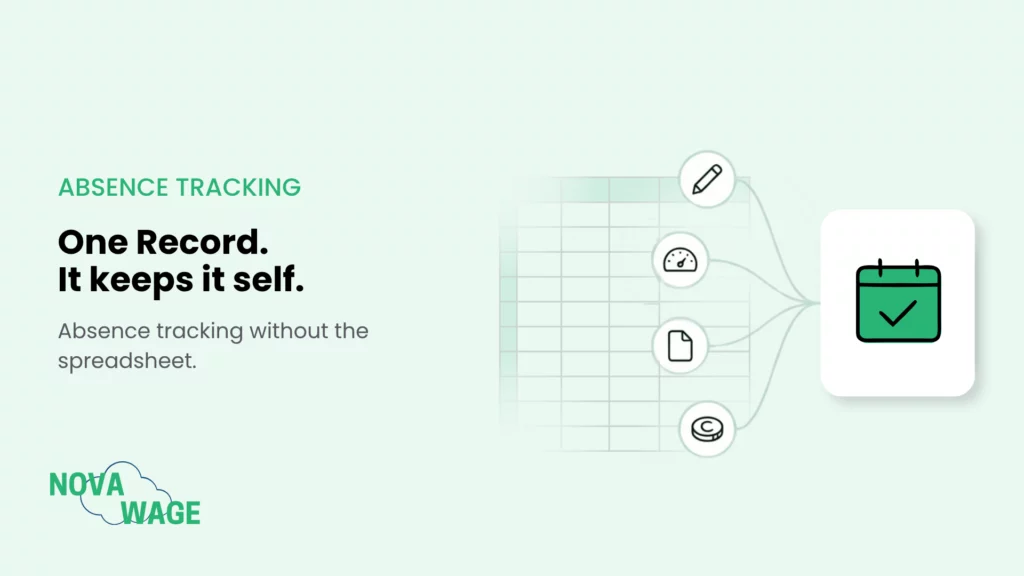
Your absence spreadsheet is probably working. That is what makes it hard to replace.
It was the right answer when there were four of you — one file, one person keeping it, one place to look. Nobody sets out to track employee absences without spreadsheets. You get there because the file drifts: a day agreed in a corridor and never entered, a balance that is exact in April and approximate by October, a formula that stopped one row short of the last hire.
This is about the four jobs a shared file was never built to do — and what a calmer record looks like. Not an argument that the spreadsheet was a mistake.
Why the spreadsheet got the job in the first place
A spreadsheet is honest about what it is. It costs nothing, needs no training, and shows you the whole year at once — one screen, every name, every column. Nothing else on your desk does that.
For a team of five with predictable summers, a well-kept file genuinely is enough. Plenty of Swiss SMEs run on one and never have a problem.
What changes is not the file. It is how many people now depend on the one person who updates it.
What tracking employee absences without spreadsheets really involves
Underneath the columns, a record of absence is doing four separate jobs. A spreadsheet does the first one well and the other three only as well as the person maintaining it.
Stay current between the yes and the writing-down.
Requests arrive at the worst possible moments — mid-quote, mid-client, on the way out the door. You say yes in three seconds. Writing it down takes longer than saying it, so it waits.
Most of the time it gets entered that evening. Sometimes it doesn’t, and then the file is quietly wrong in a way nobody notices until two people book the same fortnight.
Answer the balance question without you
“How many days do I have left?” is a small question that only you can answer, because only you can see the file.
The arithmetic underneath it is not small: days accrue through the year, part-time entitlements are proportional, and untaken days do not disappear on 31 December. The federal minimum is set in law, many contracts grant more, and public holidays and paid absences sit alongside it.
Every time that question comes to you, the answer costs you an interruption and costs your employee a wait.
Hold a record you could show a year from now
Swiss employers are expected to be able to produce records of working hours, rest and absence, and to keep them available for five years. A spreadsheet is an accepted way to hold that. What it cannot do is prove when a line was entered, or who changed it.
Medical certificates add a second consideration: they are health data, and they belong somewhere access-controlled rather than in a shared drive.
The duty to be able to show the record stays with you either way. What changes is whether producing it costs you an afternoon of scrolling.
Feed the vacation provision without manual recalculation.
Every vacation day still sitting on the balance is a financial commitment. At year-end close, untaken days have to be valued into an accounting provision, a calculation that depends directly on each employee’s exact balance.
When that balance lives in a file that drifts, the provision drifts with it. A two or three day error repeated across ten employees is already a discrepancy that reaches the balance sheet.
This is where a spreadsheet’s quiet errors become expensive, because accounting is where they finally get noticed.
A record that keeps itself
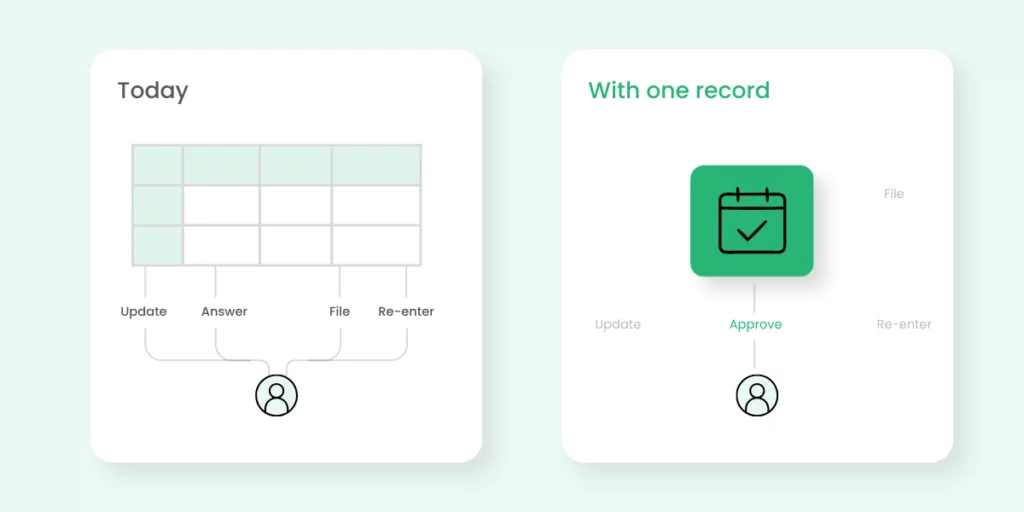
The fix is smaller than swapping one tool for another, and it is structural rather than technical: the request is entered by the person making it, in the place where the record already lives.
That single change does most of the work. The balance is visible to the employee, so the question stops arriving. The entry happens at the moment of the request, so there is no evening backlog. The record updates itself, so the month does not end in reconstruction.
The answer is not a better-built spreadsheet. It is not having to be the one who keeps it current.
What that looks like in NovaWage
Our Absence module is built around one idea: you should be the approver, not the administrator.
The screen is deliberately plain. What lets it stay plain is three decades of Swiss HR and payroll rules already solved underneath — entitlement, proration, carry-over, cantonal variation — so none of it has to appear as something you configure.
Your team submits, and sees their own balance
Employees request holiday and upload a medical certificate from their phone or browser, and see their remaining days without asking you.
You approve in one tap
The request reaches you as a notification. You approve or decline in one tap, and the employee is told automatically. The staffing calendar shows overlapping requests before you say yes, so an understaffed week is visible in advance.
The balance feeding your provision stays current.
Every approved request updates the employee’s holiday balance the moment it’s confirmed. For your accounting team, that means a vacation provision calculated on accurate figures, with no manual catch-up at year-end. Employee data is hosted in Switzerland, on ISO 27001 certified infrastructure, handled in line with nFADP requirements, which matters most for the certificates sitting inside sick leave.
The month that ends without a reconstruction
Absence will keep arriving the way it always has — at bad moments, in fragments, usually in July.
What can change is where it lands. When the record keeps itself, the balance you quote in October is the same one your employee sees. When the month closes, there is nothing to piece back together from messages. And when someone asks what they have left, they already know.
“You built a spreadsheet because nothing else would hold it all. Something else will now.”
See the Absence module in full
Self-service requests, one-tap approvals, the staffing calendar, and absence that reaches payroll on its own — with pricing published openly, per employee, per month. No demo booking, no sales call.
See how we lighten your admin