It usually starts with a small doubt.
You are closing the month and one figure does not sit right. An employee moved from Vaud to Fribourg in March. And in the back of your mind: would a spreadsheet be a good enough answer if someone asked how you store employee data?
Swiss payroll compliance is complex — not because owners are careless, but because it is layered: federal rules, cantonal rules, certification standards, and a data protection law that changed who is personally responsible.
This guide maps all four in plain language. No jargon, no scare tactics.
Why Swiss payroll compliance is harder than it looks
Most payroll guidance written in English assumes a single national system. One tax authority, one set of thresholds, one filing deadline. That is not how Switzerland works.
Swiss payroll compliance sits at the intersection of four separate rulebooks, and each one can change independently of the others:
- Federal social insurance — AVS/AHV, AI/IV, APG/EO, unemployment insurance, and occupational pension (LPP/BVG), each with its own contribution logic and thresholds.
- Cantonal tax rules — including source tax rates and scales that differ from canton to canton.
- The Swissdec standard — the certified format in which your salary data must be transmitted to authorities and insurers.
- Data protection — how you collect, store, and protect the personal information behind all of the above.
Any one of these is manageable on its own. It is the combination that catches people out — particularly when an employee’s situation changes mid-year.
You are not running one payroll system. You are running twenty-six.
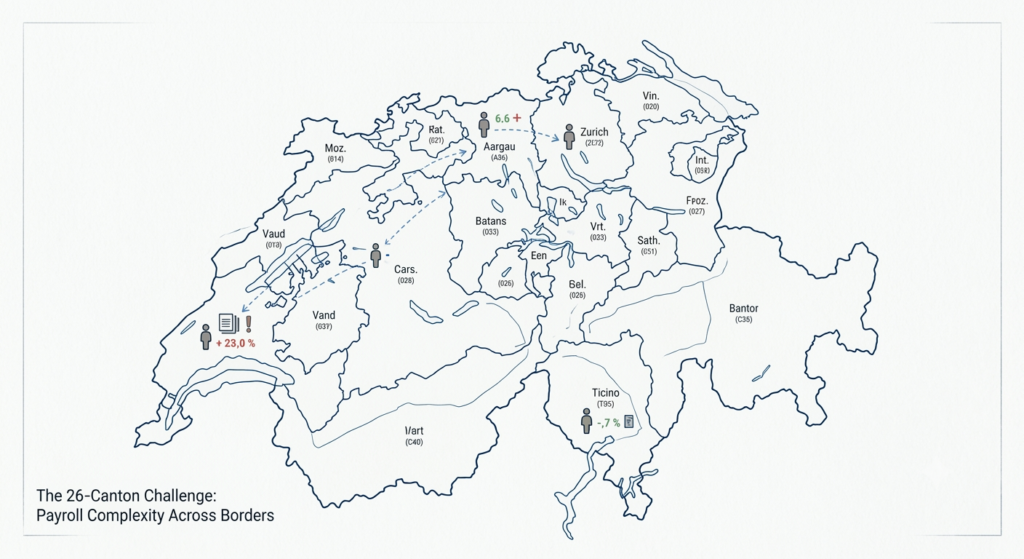
Switzerland has 26 cantons, and payroll does not stop at the cantonal border.
An employee’s source tax depends on where they live, not only where they work. If someone moves canton, their rate can change. If they marry, have a child, or take on a second job, their tax scale can change. If they cross a border to get to work each day, an entirely separate set of rules may apply.
For a business with five employees in one canton, this is a small administrative task. For a business with fifteen employees across two or three cantons — which is exactly the profile of a growing Swiss SME — it becomes a monthly research project. And research projects done at 9pm on a Thursday are where errors live.
The five rules that shape Swiss payroll compliance
Here is what each layer actually requires of you
1. Federal social insurance — what every employee costs you
This is the layer that applies to everyone. Every employee on your payroll, regardless of nationality or permit, triggers a set of federal social insurance contributions — and most are split between you and them.
The core components are old-age and survivors insurance (AHV/AVS), disability insurance (IV/AI), loss-of-earnings compensation (EO/APG), unemployment insurance (ALV/AC), accident insurance (UVG/LAA), and occupational pension (BVG/LPP). Family allowances sit alongside them, administered at cantonal level.
Each has its own base, its own ceiling, and its own split between employer and employee. Accident insurance divides again depending on whether the accident happens at work or outside it. Occupational pension only kicks in above an entry threshold, and the deduction is calculated on a coordinated portion of salary rather than the full amount.
None of this is optional and none of it is negotiable. It is simply the arithmetic that turns a gross salary into a net payslip and an employer cost — and it is where a single wrong threshold quietly repeats itself twelve times a year.
2. Source tax — the calculation that changes with every move
Source tax (impôt à la source / Quellensteuer) applies to employees whose income tax is deducted directly from their salary rather than assessed separately — typically foreign nationals without a C permit, and cross-border commuters.
The tricky part is not the deduction itself. It is that the correct rate depends on a set of personal circumstances that move: canton of residence, marital status, number of children, whether a spouse also works, and whether the employee holds more than one job. Each of these can shift the applicable scale.
Since the source tax reform, employers have also had a clearer obligation to settle with the correct canton and to apply the right scale from the right month. Getting the timing wrong is one of the most common corrections we see.
3. Cantonal rules — the layer most software forgets
Beyond source tax, cantons differ in ways that reach into payroll: family allowance rates, certain contribution details, and the specific offices you file with.
This is the layer where generic international payroll tools tend to fall short. They handle the federal picture competently and then leave the cantonal detail to you — which puts you right back where you started, cross-checking a rate table at the end of the month.
4. Swissdec 5.0 — the standard your salary declaration must speak
Swissdec is the Swiss standard for transmitting salary data. Rather than filing separately with the AVS compensation office, the tax authorities, accident insurers, and statistics offices, a Swissdec-certified system lets you send one certified declaration that reaches all of them.
Version 5.0 is the current generation of the standard. Software that carries the certification has been formally tested against it, which is why the certification matters more than any feature list: it is external, verifiable proof that the calculations behind your payroll have been checked by someone other than the vendor selling it to you.
If you are evaluating payroll software, this is the first question to ask — not the last.
5. The nFADP — your employees' data is now your responsibility
The revised Federal Act on Data Protection (nFADP, or nLPD in French) came into force in September 2023, bringing Swiss data protection law closer to European standards.
For an employer, three things changed in practice. You need to know what employee data you hold and why. You need to be able to explain how it is protected. And — the part that surprises most owners — penalties under the nFADP can be directed at responsible individuals, not only at the company.
That is not a reason to panic. It is a reason to stop keeping salary records in a shared spreadsheet folder and move to a system built to hold them properly.
What it costs when something slips
Most payroll errors are not dramatic. They are small, quiet, and repeated — a rate applied one month late, a scale that was never updated after an employee’s situation changed, a declaration filed to the wrong canton.
The consequences are correspondingly ordinary. Corrections and back-payments. Time spent reconstructing what happened months ago. Sometimes an awkward conversation with an employee whose payslip was wrong.
But there is a quieter cost too. Owners who are not confident in their payroll tend to check it more than once. That double-checking is invisible on any balance sheet, and it is often the single biggest time drain in a small business’s admin week.
The goal of compliance is not to avoid a worst-case scenario. It is to stop spending your attention on something that should simply be correct.
How NovaWage carries the compliance weight for you
We built NovaWage on a straightforward idea: the software should be the expert, so you do not have to be.
The interface is deliberately simple. What makes that simplicity possible is three decades of Swiss payroll knowledge working underneath it — the rules, the edge cases, and the cantonal detail already encoded, so nothing is left for you to look up.
The Smart-Validate Engine
Our payroll engine is Swissdec 5.0 certified. On top of that certification, we run a validation layer that checks your entries before anything is transmitted — flagging tax inconsistencies, unusual figures, and the kind of edge cases that are easy to miss when you are running payroll at the end of a long month.
Twenty-six cantons, already built in
Cantonal logic is not a setting you configure. It is part of the system. When an employee moves, changes status, or joins from another canton, the correct rules apply automatically.
Your data stays in Switzerland
Employee data is hosted in Switzerland, in ISO 27001 certified infrastructure, aligned with nFADP and GDPR requirements. When someone asks how you protect your employees’ personal information, you have a straight answer.
Payroll you no longer have to think about
Swiss payroll compliance will not get simpler. Cantons will keep their differences, standards will keep evolving, and data protection expectations will keep rising.
What can change is how much of that lands on your desk.
Reading about compliance and watching it handled are two different things. Our Payroll module page shows the full salary run — from entering hours to a certified Swissdec declaration, with the validation layer catching issues along the way. Pricing is published openly, per employee, per month.
You do not need to become a compliance expert. You need a system that already is one — so that when you close the month, the only thing you feel is that it is done.
See how we handle your payroll
No demo, no sales call — just the product, and the price.
See the payroll module