
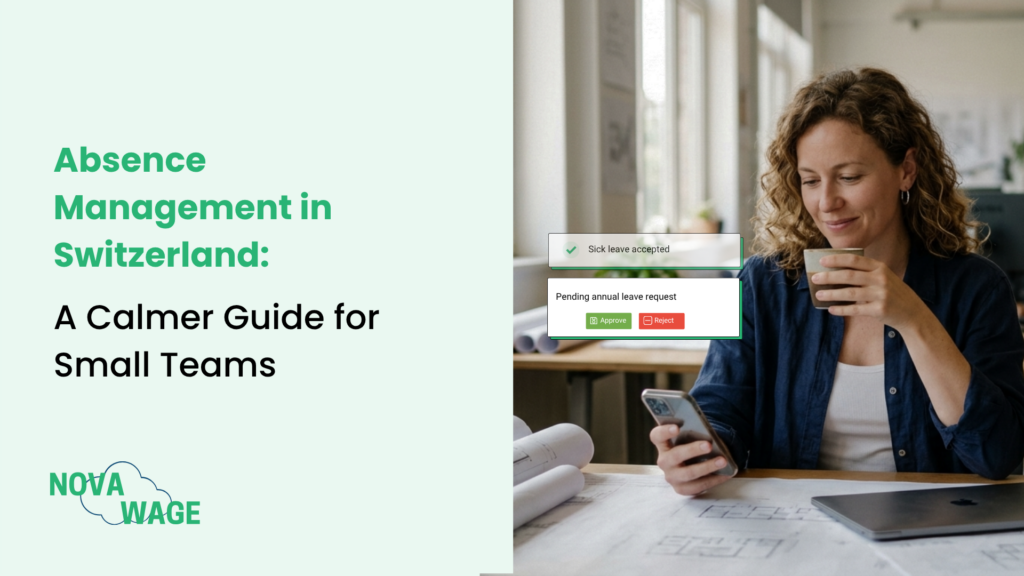
Someone is going to ask you for two weeks off today.
They will ask by email, or by WhatsApp, or by leaning through your office door. You will try to remember whether anyone else is away that week, whether they have the days left, and where you wrote down the last request. Then you will say yes — and where that gets written down depends on what is open in front of you: a note on your phone, a Word file, the shared calendar, the spreadsheet.
Absence management in Switzerland rarely feels heavy in any single moment. It becomes difficult because it arrives in fragments — a message here, a doctor’s note there, an overtime hour someone mentions in passing — and because you are the only place all those fragments meet. And in Switzerland they carry weight — a sick day can suspend a notice period or trigger salary continuation, so the record matters as much as the day off.
This guide is about moving that meeting point off your desk.
Where absence management in Switzerland actually takes your time
It is worth adding up honestly how much of your month absence actually takes. For some owners it really is minor — a handful of requests a year, a team that plans ahead, a rhythm that works. For others it turns out to be the better part of a day, spread so thin across so many small moments that it never looked like a day.
The tracking itself is quick. What is slow is everything around it: checking whether the days are available, remembering who else is off, telling the person, telling the team, updating the record, and — at the end of the month — reconstructing all of it for payroll.
Small teams also have less margin than large ones. In a company of two hundred, two people off in the same week is a scheduling detail. In a company of twelve, it can be the difference between a normal Tuesday and cancelling a client.
The request that touches four places
Follow one holiday request through a typical Swiss SME and you will find it lands in at least four places.
It arrives in your inbox. It gets checked against a shared calendar or a spreadsheet of remaining days. It gets communicated back to the employee, and often to a colleague who needs to cover. Then, weeks later, it appears again at payroll time — as a balance to adjust, or an unpaid day, or an overtime offset.
Four touchpoints, and you are present at every one. Multiply by fifteen employees and a year of requests, and you have built yourself a second job you never applied for.
None of this is a failure of organisation. It is what happens when the system of record is a person.
What you are actually obliged to track
Before fixing the process, it helps to know what the law expects you to be able to show. For a small Swiss employer, it comes down to four categories.
1. Holiday — the entitlement that carries forward
Swiss employees are entitled to a statutory minimum of paid holiday each year, with a higher minimum for employees under the age of 20. Many contracts and collective agreements grant more.
The part that trips up small teams is not the entitlement. It is the balance: days accrue through the year, part-time entitlements are calculated proportionally, and untaken days do not simply vanish at the 31st of December. If your record of who has what is a spreadsheet that one person updates, the balance is only as accurate as the last time that person remembered.
2. Sick leave — where a note becomes a legal record
Continued salary payment during illness is an employer obligation in Switzerland, and the duration depends on length of service and which cantonal scale applies to your business. Many employers also hold daily-sickness-benefit insurance that takes over after a waiting period.
That means a sick day is not just an absence. It is a date that starts a clock, a medical certificate you may need to produce later, and — because it is health-related — a piece of personal data that deserves more protection than a shared folder gives it.
The dates carry a second consequence, and it is the one small employers most often meet by surprise. Swiss law protects employees from dismissal during illness for a defined period tied to length of service. Notice given inside that window does not take effect, and a notice period already running is suspended until the protection ends. Whether a particular absence falls inside that window is a question of dates — which is answerable in seconds if the record was kept properly at the time, and a genuine problem if it was not.
3. Overtime and working hours — the record you must be able to produce
Swiss labour law requires employers to record working time, with some simplified regimes available for certain employees. Overtime and excess hours are treated differently from one another, and each carries its own compensation logic.
If a labour inspector or an employee ever asks what hours were worked in a given month, the answer needs to exist somewhere other than memory.
Learn more about overtime and working hours from here.
4. Parental and family leave — the newest layer
Maternity leave, paternity leave, adoption leave, and leave to care for a family member each have their own entitlement and their own interaction with payroll.
They are also the layer most likely to catch a small employer by surprise, simply because each one comes up rarely. Nobody builds a reliable habit around something that happens once every three years.
Learn more more about these leaves from here.
Four categories, and the useful question after reading them is not whether you know the rules. It is whether your own records would answer for all four if someone asked tomorrow.
The hidden cost is not the admin. It is the interruption.
Add up the minutes and absence management looks small. The minutes are not the problem.
The real cost is the shape of the work, not its size. A holiday request does not wait for a convenient moment. It arrives while you are with a client, mid-quote, at the end of a long day. Each one is short. Each one pulls you out of something else.
There is a second cost that shows up later. When the record lives in several places, the end of the month becomes an act of reconstruction — scrolling back through messages to work out what was agreed in week two. Reconstruction is where mistakes get made, and mistakes in someone’s holiday balance are the kind employees remember.
The goal is not to spend less time on absence. It’s about putting an end to interruptions, distractions, and oversights.
A calmer way to run absence management
The fix is structural, and it is simpler than most owners expect: let the request live in one system, and let the people making the request do the entering.
That single change does most of the work. The employee sees their own balance, so they stop asking you what it is. The request lands in one place, so there is nothing to reconcile. The record updates itself, so there is nothing to reconstruct at month-end. And your involvement shrinks to the only part that genuinely needs your judgement — saying yes or no.
This is what we mean by effortless people management. Not fewer decisions. Fewer steps around each decision.
How NovaWage takes the middleman role off your desk
Our Absence module is built around one idea: the owner should be the approver, not the administrator.
The screen is deliberately plain. What makes it possible to keep it plain is three decades of Swiss payroll and HR knowledge working underneath — entitlement rules, part-time proration, cantonal variations, and the link into salary already solved, so none of it needs to appear as a setting you configure.
Employees manage their own requests
Your team gets a mobile self-service app. They see their remaining holiday, submit a request, and upload a medical certificate — without emailing you to ask what their balance is.
One tap to approve, from wherever you are
When someone on your team submits a request, it reaches you as a notification. You approve or decline in one tap, on the train or between meetings. The record updates the moment you do, and the employee is told automatically — so nobody has to chase you for an answer, and you do not have to remember to give one.
A calendar that shows you the gaps before they happen
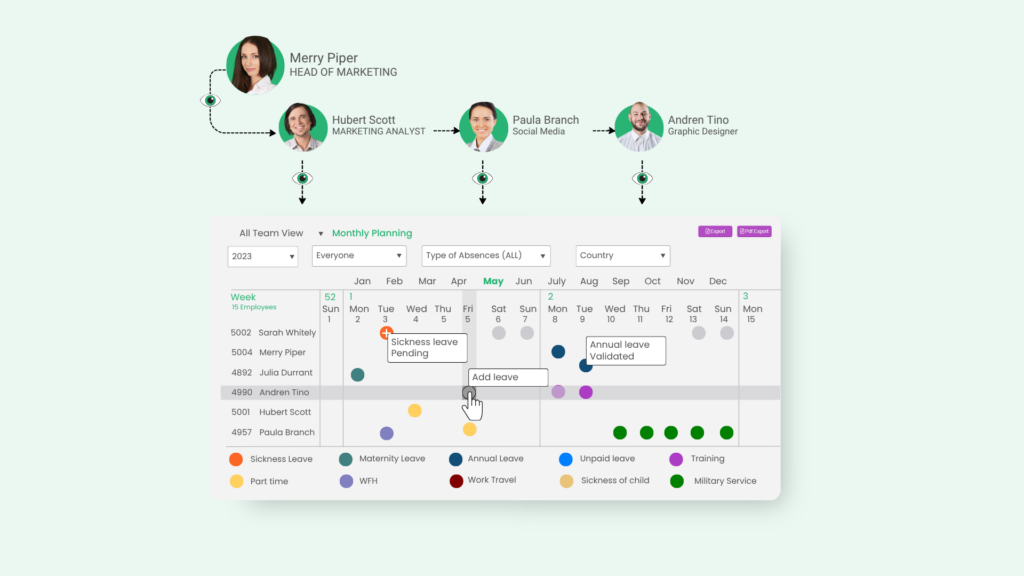
The visual staffing calendar shows the whole team on one screen, with overlapping requests visible before you approve them. You see the understaffed week in advance rather than discovering it on the Monday morning.
Absence that arrives in payroll on its own
Every approved day flows into your monthly salary run through the Time-to-Pay bridge — no re-entry, no second spreadsheet, no month-end reconciliation. Employee data is hosted in Switzerland in ISO 27001 certified infrastructure and handled in line with nFADP requirements, which matters especially for the health-related records that sit inside sick leave.
Your first week, realistically
Switching absence management is smaller than it sounds, and it helps to see it as three steps rather than a project.
First, you describe your company and set up your vacation entitlement rules once. Next, you enter your employees’ information and verify that the system has correctly calculated their entitlements—so that no one inadvertently starts the year with zero vacation days. Finally, your team downloads the app.
Most small teams are running properly within a week. The turning point often comes with the first request: a notification that you can handle in a single tap, without having to look anywhere else.
Getting your Sundays back
Absence management in Switzerland will keep its complexity. Entitlements will keep accruing, certificates will keep arriving, and someone will always need two weeks in July.
What can change is how much of that has to pass through you.
When the record keeps itself, the month ends without a reconstruction exercise. When your team can see their own balance, they stop asking. And when a holiday request takes one tap instead of four touchpoints, you get back something more valuable than the minutes — the ability to finish what you were doing.
Reading about it and watching it run are two different things.
See the Absence module in full
Self-service requests, one-tap approvals, the staffing calendar, and the bridge into payroll — with pricing published openly, per employee, per month. No demo booking, no sales call.
See how we lighten your admin