
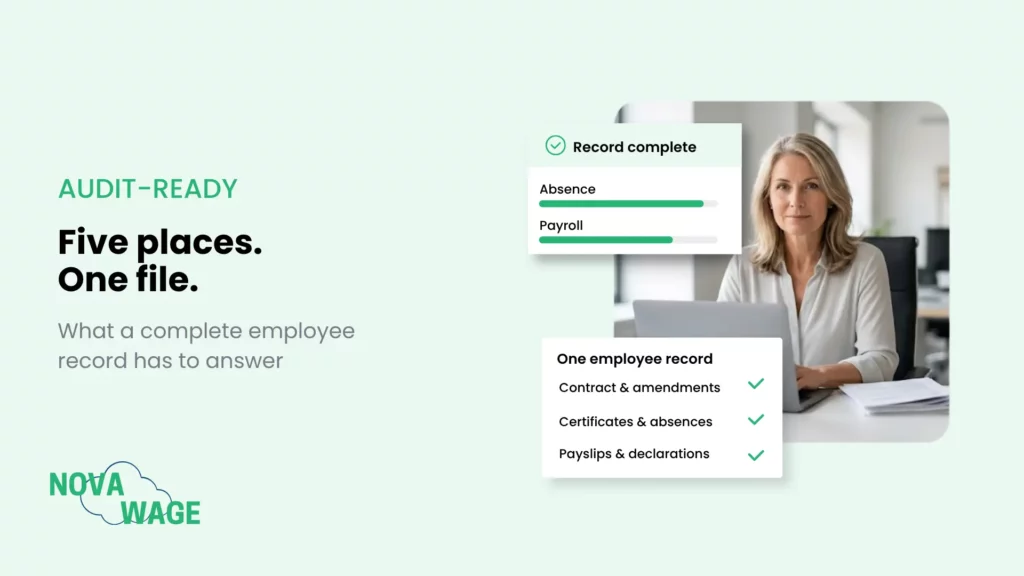
Someone asks you for everything you hold on one employee. Not a summary — the contract and every amendment, the absences, the certificates, the salary changes, the pay slips.
How long would that take?
For most small employers the honest answer isn’t a number. It’s a list of places to look.
What audit-ready employee records really ask of you
Audit-ready is not a filing standard — nobody inspects how tidy your folders are. It is a retrieval test. When someone with the right to ask — a compensation-fund inspector during an OASI (AHV) employer inspection, an auditor, or the employee themselves — asks what you hold and what was agreed, you produce it: completely, within a reasonable time, with nothing that contradicts anything else.
So a record can be well kept and still fail the test, if the keeping is spread across five systems and one person’s memory.
Where the pieces usually live
The pieces of an employee’s history arrive separately, and they are usually kept wherever they arrived.
A contract in a folder, or an email attachment from three years ago. The amendment when someone moved to 80%, agreed in a meeting and confirmed in a message. Certificates wherever they were sent. Pay slips in payroll. The leave balance in whatever tracks absence.
None of that is disorganised. Each piece is where someone sensibly put it at the time. The record isn’t missing — it’s distributed, and that only shows when someone asks for all of it at once.
Swiss law is specific about one half of it. Under the Ordinance on the Keeping and Preservation of Business Records — the GeBüV — records held electronically must stay inspectable by an authorised person at any time and within a reasonable period, with the equipment and programs available to read them. Payroll documents sit inside that scope. The obligation isn’t to hold the files — it’s to be able to produce them, which is what audit-ready employee records means in practice.
→ Read the full guide: The Cost of Disconnected HR and Payroll.
The three questions a complete record answers
Whoever is asking, they are usually after one of three things.
What was agreed
The contract and every change since — workload percentage, salary, function, notice period, and the date each of those changed.
Swiss law already requires the essential terms of employment to be set out in writing, and an amendment is no less essential than the original. This is the layer most likely to have gaps: changes get agreed in conversation and confirmed in a message. The agreement is real; the paper trail is wherever that conversation happened.
What actually happened
Absences and their certificates, plus leave taken and carried over.
A medical certificate is health data under the nFADP, and the federal data protection commissioner treats each phase of employment as carrying its own duties. It deserves more protection than a shared folder gives it — a separate question, but one that starts with knowing where the document is.
What was paid
Pay slips, the deductions behind them, and the declarations that went out. Usually the most complete layer: payroll systems are built to keep it, it has to reconcile, and it falls squarely under the GeBüV. It is also what an OASI inspection asks about.
The difficulty is not that this layer is missing. It’s that it sits apart from the other two, so nobody sees an employee’s whole history in one view.
One file, and what it changes
The alternative isn’t more discipline about filing. It’s one file per employee that everything lands in by default.
Personal, family, tax and banking details entered once. Documents attached to the person rather than an inbox. Every change — percentage, salary, address, leave taken — in that same centralised history, so “what was their situation in March?” is one file rather than five searches. Access follows roles, so whoever should see a certificate can, and whoever shouldn’t, can’t.
Find out what this looks like in practice: the profile, the documents on file, the contract and access rights → Employee database software
It is the same record payroll and absence both work from — the argument of the pillar this post belongs to.
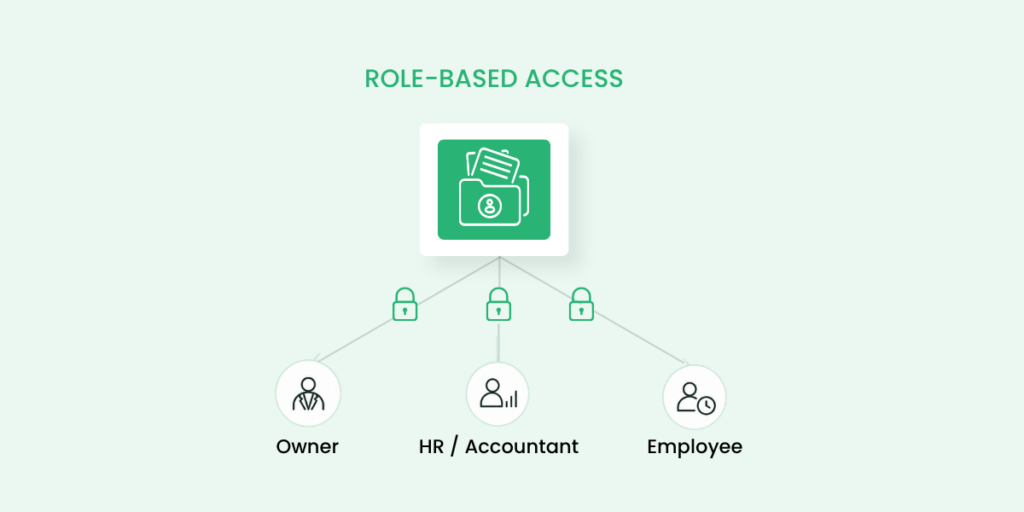
→ Read the full guide: Separate HR and Payroll Systems: The Case for One Record
Keeping it complete without thinking about it
A complete record is easy to assemble once and hard to keep, which is the wrong way round: the moment you need it is never the moment you built it. What makes it hold is that completeness stops being a task. Documents attach where they belong because there is one obvious place. History accumulates because nothing overwrites it. And the file exports as CSV, XLSX or PDF, so producing it is a download rather than a project.
Employee data is hosted in Switzerland on ISO 27001 certified infrastructure and handled in line with nFADP and GDPR. How long each part must survive after someone leaves is a question of its own.
The short answer to “how long would it take?”
Most employers can eventually produce everything. That was never the question. The question is what eventually costs — the afternoon of searching, the thread nobody can find, the amendment agreed but never written down, the quiet worry that something is missing with no way to be sure.
With one file, the answer is the time it takes to open it.
Nobody keeps records for their own sake. You keep them so that the day someone asks is an ordinary day.
One complete record per employee
First day to latest pay slip, in a single place — with absence and payroll working from the same file. Pricing published openly, per employee, per month.
See how we connect it all