Monday morning. Someone wants to know how many holiday days they have left. Someone else needs their March payslip for a mortgage application. A third is asking whether Thomas is already off that week, because if he is, they’ll move theirs.
None of those are unreasonable questions. Every one of them is something a person genuinely needs to know.
They just all happen to be things the person asking could have looked up.
What employee self-service actually changes
Employee self-service gets sold as a portal. That undersells it and also mis-describes it: nobody wants another login.
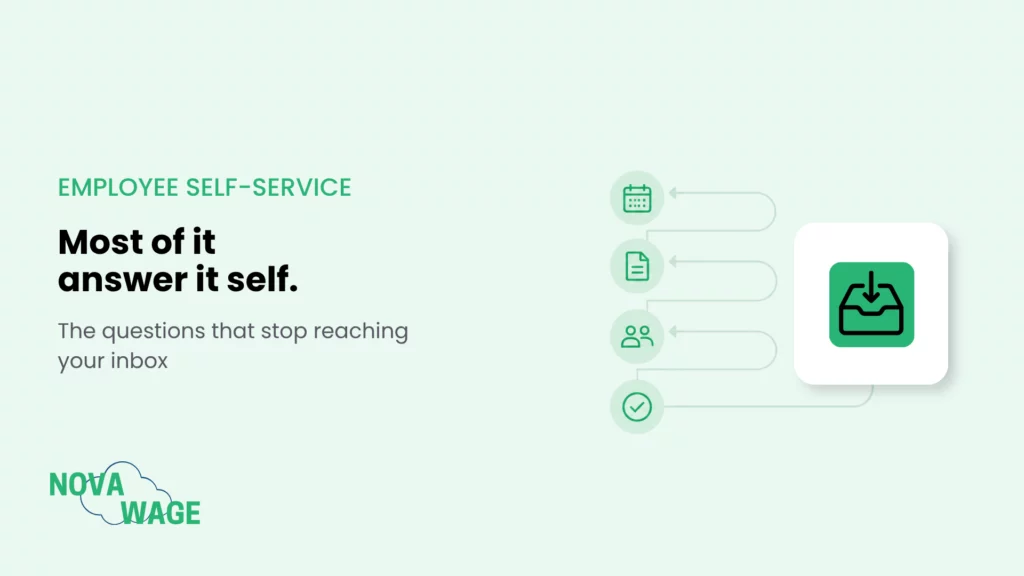
What it actually changes is traffic. Right now, questions about an employee’s own information travel to whoever holds that information — which is how one inbox ends up holding everyone’s answers. Self-service doesn’t answer those questions faster. It stops them being asked, because the answer is already where the person asking is.
That is a different promise from “saves time.” Time saved comes back in fragments. What changes here is the number of interruptions, and interruptions are the part of admin that costs more than the minutes it takes — a point the pillar this post belongs to makes at length in our guide to absence management in Switzerland.
How much of an inbox is just lookup
Not every message that reaches you is a request. Most are one of three things, and only one of them needs you.
Lookups. How many days do I have left. When did I take those two days in June. Can I see my payslip from March. The answer exists already; it just isn’t somewhere the person can reach.
Coordination. Is anyone else off that week. Would it be a problem if I took the Friday. These are employees trying to be considerate, and they ask you because you are the only one who can see everyone’s calendar.
Decisions. Please approve this. This is the one that actually requires you, and in most inboxes it is the smallest of the three.
Sort a week’s messages into those piles and the shape of the problem is usually clear enough without counting.
The approval that doesn't have to be yours
Here is the part most self-service write-ups leave out, and it matters more than the portal.
Approving absence does not have to route through one person. Approval responsibility can be split across several managers — so a request doesn’t wait for you specifically, and a week away doesn’t turn into a queue.
That is worth more than any amount of speed. A faster approval still needs you to be there. A second approver means the business keeps moving when you aren’t.
When a request does land with you, it arrives as a notification and goes back as a decision — approve or decline, from wherever you are, in bulk if several are waiting. The employee is told automatically, which quietly removes a second category of message: the follow-up asking whether you saw it.
And for the person who won’t use the app — the one phoning in sick, or the one without a work phone — a manager can submit the request on their behalf. Self-service doesn’t have to be universal to be useful, which is usually the first objection to it.
Three things they can answer without you
Their own balance. Remaining days, days already taken, and the requests they have in flight. They can submit a new one, edit it, or withdraw it entirely without asking you to undo anything.
Each other’s calendar. A shared view of who is already away, with visibility set by role. This is the one that changes behaviour rather than just saving a message: people resolve overlaps between themselves before a request ever reaches you, because they can see the problem coming.
Their own payslips — though this one comes from the payroll side rather than the absence side. Payslips publish to the employee portal each month in French, English or German, and the archive stays there. Mortgage applications, tax returns, a landlord’s reference: the requests that always seem to arrive at the wrong moment. Leave and payslips sitting behind the same login is what the full suite is for; absence self-service on its own stops at leave.
A sick note goes the same way — photographed and attached to the request rather than emailed to you. Worth knowing that a medical certificate is sensitive personal data, so keeping it inside the record rather than in a mailbox matters for more than tidiness; what the nFADP asks about employee data covers that properly. All of this sits on the phone they already have — the NovaWage mobile application is where employees do it.
What self-service does not fix is the record underneath. If absences live in a spreadsheet, giving people access to the spreadsheet is not an improvement — tracking absences without spreadsheets is the step before this one.
An inbox that only holds decisions
he goal was never an empty inbox. It was an inbox that only contains things that need a person.
Lookups answer themselves. Coordination resolves between the people doing the coordinating. What is left is the small set of decisions that genuinely require your judgement — and those arrive one tap wide, wherever you are.
“ Nobody started a business to answer questions about holiday balances. Handing those back is not a loss of control — it is a return of attention. “
Absence that manages itself
Employees see their own balance, submit their own requests and attach their own certificates. You approve — or someone else does. Pricing published openly, per employee, per month.
See how we lighten your admin