
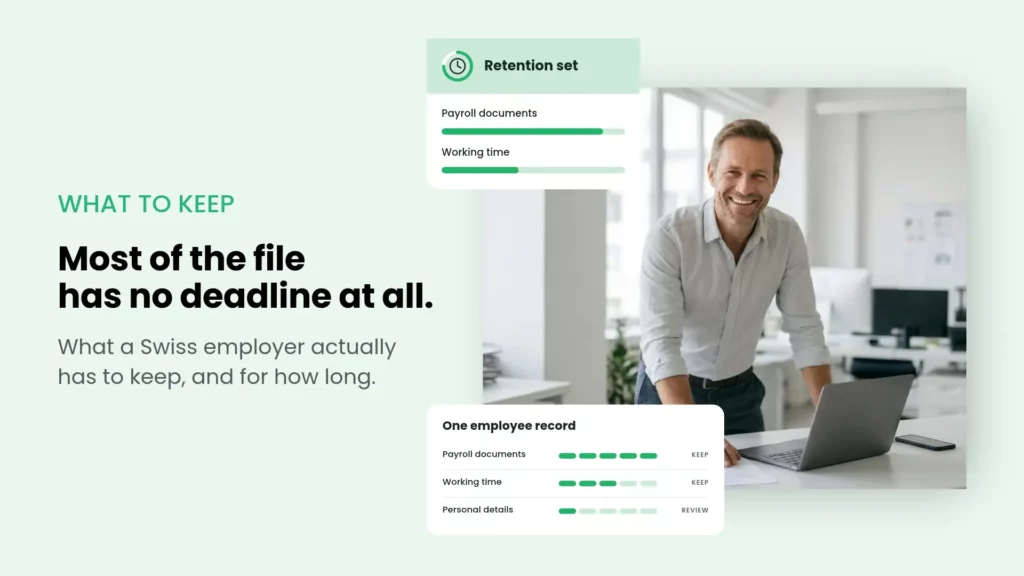
Search for how long to keep employee records in Switzerland and you will be told ten years, repeatedly and confidently.
That figure is real. It just does not apply to the whole file — because personnel file retention in Switzerland runs on more than one clock.
Personnel file retention in Switzerland is not one rule
A personnel file is not one kind of document. It is payslips and deductions, a contract and its amendments, working-time records, medical certificates, performance notes, an address and a bank account.
Swiss law treats those differently. Some have a fixed period. Some have a shorter one. And a good deal of the file has no stated period at all — which is the part most guidance skips, because it is the part with no tidy number.
Three clocks, then. Here is each one, and what it actually asks of you.
Ten years: payroll
This is the figure everyone quotes, and for payroll it is right.
Payslips, deductions, the payroll journal — anything that counts as an accounting record gets ten years. The clock starts at the end of your financial year, not on the employee’s last day.
Two things follow, and they are the ones that matter in practice.
You cannot clear payroll data out when someone leaves. Not after a year, not after five. The person goes; their payroll record stays.
And whatever you keep has to still open in ten years’ time. That is a question about your software, not your filing cabinet, and it is the part almost nobody plans for.
In short: payroll is the one part of the file you are not allowed to tidy.
Can digital files replace the paper originals?
Yes. Scan them, shred the paper, keep the file. That is allowed.
The law lets you hold records “on paper, electronically or in a comparable manner” — as long as what you keep still matches the real transactions, and you can make it readable again at any time.
Four conditions come with that, and they are less fussy than they sound:
- What you store cannot be quietly changed later
- If it can be, something technical has to prove it was not — an electronic signature, for example
- The record of when it was filed has to be trustworthy too
- The access logs count as part of the record
A cloud backup on its own does not count. Copying files into cloud storage is not the same as keeping them unalterable. It is the most common mistake here, and it is worth ten minutes checking what your current setup actually does.
One narrow exception, because it gets misquoted: the annual report and the audit report have to be kept printed and signed. That is a company-accounts rule about two documents. Payslips and employment contracts are not affected.
In short: digital is fine. Unalterable is the requirement — and cloud storage alone is not it.
Five years: the hours you have to record
If you are required to track working time, that record runs on its own, shorter clock: at least five years . You keep the records, and you produce them if you are asked.
It comes from a different law from the payroll one, which is exactly why it catches people out. You can be perfectly in order on payroll and short on this.
In short: if you track hours, do not assume the ten-year rule has you covered. It does not.
No number at all: everything else
Here is the part the ten-year advice quietly omits.
The contract and its amendments. The medical certificates. The performance notes. The address, the bank details, the emergency contact. None of those has a retention period of its own.
What applies instead is a principle. Under the nFADP, personal data goes once it is no longer needed for the reason you collected it. That is not a number. It is a judgement you are expected to have made, and to be able to explain.
Which gives the conclusion most personnel file retention guidance avoids: for a large part of the file, keeping it is the risk. Applying ten years to everything because ten years is the number you remember is over-retention — and over-retention is a problem in itself, not a safe default.
It also means the file does not freeze when someone leaves. Payroll keeps running its ten years. The rest needs a decision. And a former employee can still ask what you hold, which does not end with the job.
In short: for most of the file, the question is not how long to keep it. It is whether you still need it.
The nFADP Checklist for Swiss
Five questions about the employee data you hold — including how long you keep it, and why. One page, written for employers rather than legal departments.
Get the nFADP ChecklistWhat a file that keeps its own clocks looks like
Personnel file retention in Switzerland is not difficult once. It is difficult repeatedly — because three clocks running at different speeds, across a file that grows every month, is not something anyone tracks by memory.
What makes it manageable is a record that knows what it is holding. Documents attached to the person, not to an inbox. A history that builds instead of overwriting. Exports in the formats a ten-year rule expects. Access that follows a role, so the people who should see a certificate can and the people who should not, cannot. One file rather than several, on infrastructure in Switzerland, certified to ISO 27001.
The clocks do not go away. They just stop being something you carry.
Nobody keeps records for ten years because they want to. They keep them so the question, whenever it comes, has a short answer.
One record per employee, from first day to final settlement
Absence and payroll working from the same file, hosted in Switzerland, with the history intact and exports in the formats a ten-year obligation expects
See how we connect it all