
What the standard is, what changed when ELM 4.0 stopped, and how to confirm your payroll software is certified for it.
If your payroll software is current, you may never have noticed the change. ELM 4.0 — the format that carried Swiss salary declarations for years — stopped being accepted during 2026. Since 1 July, a declaration sent on the old version is rejected outright by the compensation funds.
Swissdec 5.0 is what replaced it. Here is what the standard actually is, what changed, and how to confirm in about two minutes that the software you already use is certified for it.
Swissdec 5.0, in plain terms
Swissdec is the Swiss standard for transmitting salary data.
Without it, the same figures leave your business several times over: once to the AVS compensation office, again to the cantonal tax authorities, again to your accident and sickness-benefit insurers, again to the Federal Statistical Office. Each with its own format, its own timing, its own way of telling you something is wrong.
A Swissdec-certified system replaces all of that with a single certified declaration that reaches every one of them.
Version 5.0 is the version your software must currently be certified against. And the word doing the work in that sentence is certified, not compatible. Software that carries the certification has been formally tested against the standard by Swissdec — not by the company selling it to you. Check more info here
That is the whole value of it. Every payroll provider in Switzerland will tell you their calculations are correct. Certification is proof that someone else checked.
What changed when ELM 4.0 stopped
The retirement happened in two steps, and source tax went first.
Source tax declarations could be sent on ELM 4.0 only until 31 March 2026, and only for the 2025 payroll year. Every other domain — AVS/FAK, accident insurance, sickness-benefit insurance, statistics — ran until 30 June 2026. From 1 July, a 4.0 transmission is rejected by the compensation funds. For any declaration covering the 2026 payroll year, version 5.0 or higher is the requirement. Check more here.
The rejection is the part worth holding onto. It is not a filing that sits quietly in a queue waiting for someone to notice. It is a declaration that has not been made, on a date when it was due.
Source tax runs on its own timing and its own canton-by-canton logic, which is why it moved first — we cover that separately in our guide to source tax employer obligations.
How to check whether your payroll software is certified
You do not have to take any provider’s word for this, including ours.
Swissdec maintains a public register of certified payroll and ERP software. You can filter it by standard version and see every product certified for Swissdec 5.0 and for each version after it. It takes about two minutes. For more information, check here.
Three things to look for when you find your provider:
- The product name, not the company name — certificates are issued to a product. Some are sold under a different brand than the one on the certificate, so check both.
- The versions listed — a provider may be certified for 5.0 and also carry later versions. More on what those mean below.
- The certificate number — every certified product has one. It is the detail that makes the claim checkable
If you would rather not go looking, ask your provider directly for their certificate number and the ELM versions it covers. A certified provider will have both to hand.
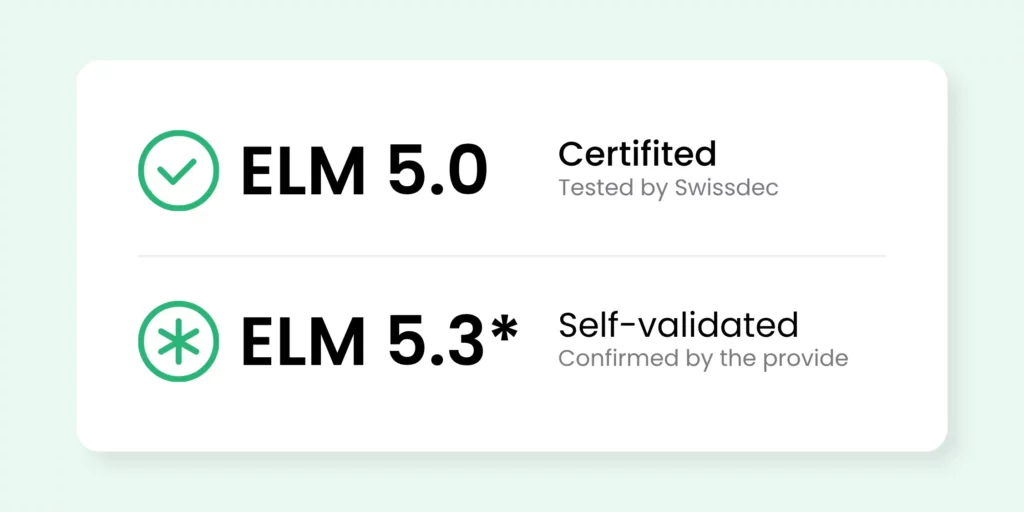
Where NovaWage sits on the register ?
NovaWage’s payroll engine is built by Novative and appears on the register as Nova Smart, certificate number 1085.25 — certified at ELM 5.0 and self-validated through 5.3.
Those are two different things, and the difference is worth understanding for any provider you look up. A certified version has been tested by Swissdec. A self-validated version is the provider’s own confirmation that the software still meets the standard after a minor update. Swissdec marks self-validated entries with an asterisk on the register, so you can always see which is which — for us and for everyone else on the list.
The version numbers that come after 5.0
Version 5.0 is the floor, not the ceiling. A few situations call for something later:
- ELM 5.1 or higher — needed for the voluntary waiver of AVS exemption.
- ELM 5.3 — covers the home-office share declaration for French cross-border workers, mandatory in 2027. If you employ frontaliers in Geneva, Vaud, Neuchâtel, Valais, Jura or Basel, this is the version to ask your provider about now rather than next year.
- ELM 6.0 — published in March 2026 with certification opening in April; it is not yet mandatory, and 5.0 remains the requirement for current declarations
Good news: these versions stack on top of each other — 5.3 also carries what 5.1 added. What matters is not the number displayed, but what the version actually lets you declare. Filing on an older version than your situation calls for is not a hard block — the fund or authority will simply follow up manually through its own portal for whatever is missing.
Payroll that clears on the first try
The point of a certified engine was never the certificate.
It is that the end of the month goes the way it is supposed to. One declaration leaves your business, reaches the AVS, the tax office, your insurers and the statistical office, and clears — the first time, without a rejection notice arriving three days before pay day.
That kind of simplicity is not simple underneath it. Thirty years of Swiss payroll rules sit behind the screen, kept current so that the screen itself can stay quiet. It is the reason plug-and-play is safe here rather than risky.
” You have a business to run. Your salary declaration should not be the part of it you think about last thing on a Sunday.”
See how we handle your payroll
No demo, no sales call — just the product, and the price.
See payroll module