
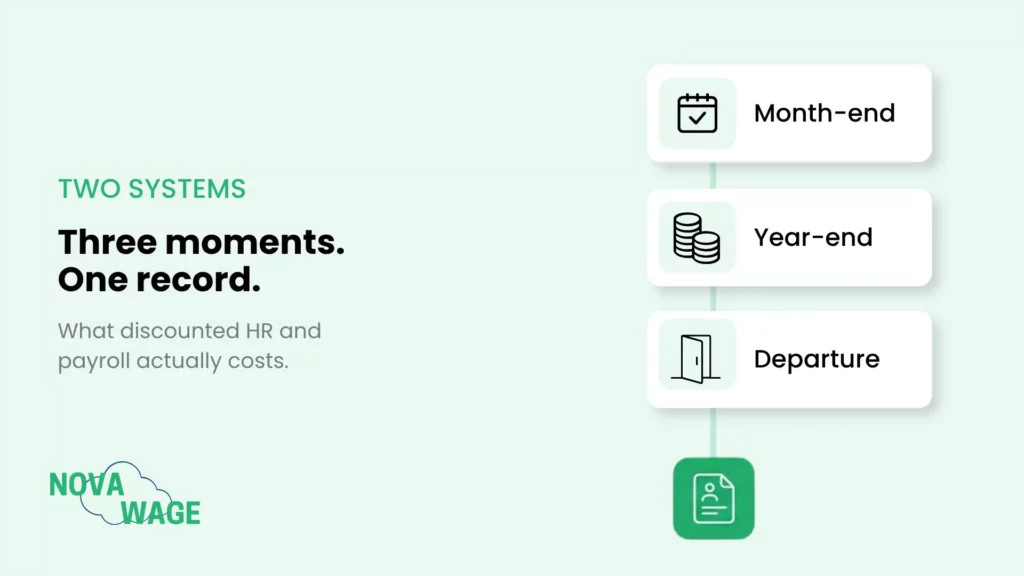
Ask a Swiss SME owner what it costs to run absence in one place and salaries in another and the honest answer is usually: nothing. No invoice arrives. No day is lost. Most weeks the two systems sit there quietly and agree with each other.
That is what makes the cost of disconnected HR and payroll hard to see. It isn’t charged monthly. It is charged at three specific moments, and two of them only come round once a year
The cost of disconnected HR and payroll is not a monthly cost
It helps to be precise about what the split actually costs, because the honest answer is: on any given Tuesday, nothing at all.
Two systems only diverge when something changes. Someone joins, someone moves canton, someone drops to 80%, someone takes a week in July, someone leaves. Each of those is one event in your business and two places it has to be recorded — and the second recording happens later, if it happens at the same time at all.
Between those events, nothing goes wrong. That is not a reassurance, though. It is the reason the bill is never attributed to the thing that caused it.
Three moments where the bill actually lands
Month-end, when the numbers have to agree
Payroll runs against what it believes about each employee. Absence is recorded somewhere else. At month-end those two beliefs have to be reconciled, and the reconciliation is manual: someone opens both, compares, and corrects.
It is rarely a long job. It is, however, a job that exists only because there are two records, and one that has to be done every month whether or not anything was wrong. The cost is not the corrections. It is the checking you cannot skip.
→ Read the full guide: How to Track Employee Absences Without Spreadsheets.
Year-end, when unused leave becomes a figure
This is where an HR number turns into a financial one.
Holiday your team hasn’t taken is not simply days outstanding. It is a provision on your accounts — a liability you carry, calculated from each person’s remaining balance and what that time is worth in salary. To produce it you need both halves accurate on the same date.
When the balance lives in one system and the salary in another, that figure gets assembled by hand, once a year, usually in the weeks when there is least room to do it carefully. And unlike a month-end correction, nobody catches an error here. It goes into the accounts.
The final settlement, when there is no time to check
Someone resigns. Their last salary has to account for holiday they didn’t take, or holiday they took in advance, alongside everything else the final payment carries.
The deadline is their leaving date, which is not negotiable, and the person best placed to spot a wrong balance is the one about to walk out the door. It is the moment a disagreement between two systems is most expensive and least likely to be noticed in time.
Why it grows instead of staying still
Here is the part that makes this different from ordinary admin: the gap does not stay the same size.
Each unrecorded change sits in the record and affects everything calculated after it. A workload change entered in one system in March and the other in May doesn’t produce one wrong month — it produces a balance that is wrong from March onwards, and a provision at the end of the year built on top of it.
Small teams also have less margin for this than large ones. In a company of two hundred, a discrepancy in one person’s balance is a rounding error someone in HR will find. In a company of twelve, that person is a twelfth of your payroll, and there is no one whose job it is to go looking.
None of this is a failure of organisation. It is what two records do over time.
What actually removes it
The fix is not a better checking routine, and it is not more discipline at the point of entry. Both of those are more work, and they leave the second record exactly where it was.
What removes the cost is removing the second record. One employee file that absence and payroll both read from means a change is entered once, a leave balance already knows the salary it is worth, and month-end has nothing to reconcile because there was never a second version to disagree with.
That is the whole argument of connected HR and payroll, and it is worth understanding properly before choosing anything.
→ Read the full guide: Separate HR and Payroll Systems: The Case for One Record
The quiet version of the same month
Nothing about two systems fails loudly, and for most of the year they cost nothing you would notice. The price is charged in December, and on the day someone leaves, and in the half-hour every month that exists only to confirm two records still agree.
With one record, those three moments get shorter rather than more careful. The provision is produced instead of assembled. The settlement comes out of the same file the balance lives in. And month-end stops being a comparison.
“Two systems were never a decision. They are just what happens when payroll arrives first and absence catches up later. ”
One employee record, both halves
Absence and payroll from one file, with vacation provisions and final settlements included. Transparent per‑employee monthly pricing
See how we connect it all